Wednesday, January 20, 2016

RPM Challenge 2015 Part IV: Twin Jet

Twin Jet Nebula in 2012
Track 3 from Impossible Universe -- Twin Jet.

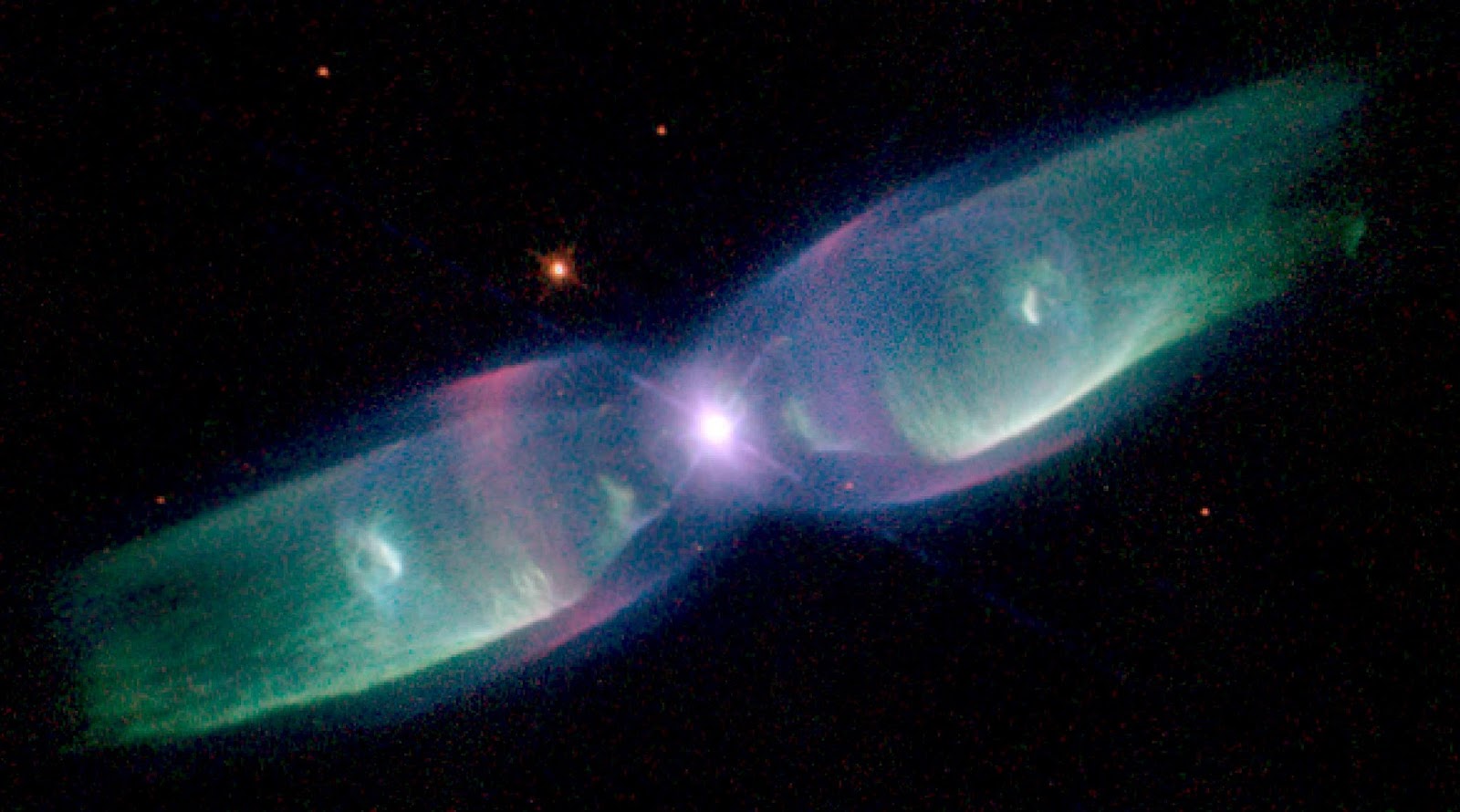
When I first saw this image of the Twin Jet Nebula (also known as the Butterfly or Wings of a Butterfly Nebula), I wondered what it was; I'd never seen anything like it before.

I found out that William Herschel discovered the first one in the 1780s and dubbed it a planetary nebula, since the center of what he was seeing in his telescope looked like a planet. Modern science has shown that "planetary nebula" is a misnomer, but because Herschel's name for these astronomical phenomena was widely adopted, it's never been changed. (1)

Twin Jet is 2,100 light-years away, in the direction of the constellation Ophiuchus. Astronomers estimate that Twin Jet is about 1200 years old.

But what causes the twin jets? Well, planetary nebulae are formed when a star is at the end of its life. It sheds it outer layers, and the exposed star core illuminates these layers.
Twin Jet Nebula in 1997
But wait, there's more! The unique colors and shape of Twin Jet Nebula's two jets are because...there's actually two stars there! Twin Jet is actually a bipolar nebula, and the jets are caused by the motion of the two stars around each other.

The blue areas on either side of the binary star system are actually jets of gas being violently shot into space at an estimated 620,000 miles per hour. (2)

If there was sound in space (which there isn't), I imagine that the Twin Jet nebula might sound like the beginning of its namesake track from Impossible Universe...


(1) https://en.wikipedia.org/wiki/Planetary_nebula
(2) https://www.spacetelescope.org/news/heic1518/

Saturday, January 16, 2016

RPMChallenge 2015 Part III: The Pillars of Creation

The Pillars of Creation
Impossible Universe's second track. The Pillars of Creation.

This cosmic spectacle was discovered when the Hubble telescope took the first close-up pictures of the Eagle Nebula in 1994. (1) This particular part of the nebula got the name "The Pillars of Creation" because of the stars forming in the dust and gases that make up these pillars.

I've seen this picture many times: NASA's APOD (Astronomy Picture of the Day), Space.com, Pinterest...(yes I have a Pinterest account with an Astronomy board...you can check it out here). But as I was searching for inspiration for this project, I ran across this again and was mesmerized by this particular close-up of the nebula.

The Eagle Nebula (M16).
The Pillars of Creation are just
off-center to the left.
Eagle Nebula is about 7000 light years away from us and can be found between the constellations Serpens and Sagittarius. The entire nebula measures 70 light-years high by 50 light-years wide, with the tallest of the pillars being about 4 light-years high. (2)

Each of the "finger-like" tips of the pillars are larger than our solar system, and contain dense knots of gasses, and stars are being formed inside some of these.

I wanted to evoke the feeling of being in some sort of space vessel floating amongst the gas, dust, and newly-forming stars. I imagined the sheer size and majesty of these pillars of creation, and what it might be like to be much, much closer to them. I realize that if we, in our imaginary spacecraft, were closer somehow, it probably wouldn't look much different than where we are now on earth, considering the sheer immensity of just that one four-light-year pillar.

Still, the song is meant to be just that; a moment in time, a snapshot of floating amongst the majesty and wonder of The Pillars of Creation.


(1) https://en.wikipedia.org/wiki/Pillars_of_Creation
(2) https://en.wikipedia.org/wiki/Eagle_Nebula

Tuesday, March 31, 2015

RPMChallenge 2015 Part II: Nebulosity (Deep Architecture)

Nebulosity (Deep Architecture), the first track from Impossible Universe, has a couple of inspirations.

I started writing it during some composing and rehearsal work for another band I've worked with called Kalaban. We were working on one of the tracks for an upcoming release, and Randy Graves, Kalaban's guitarist and composer, kept getting this error while working on it in Logic Pro X:

Deep Architecture. Please unpack some files.

...uh...how very helpful! Google was of little help, and what help Randy did find didn't seem to fix the problem.

However after seveal weeks of fighting this particularly nasty and cryptic error, Randy finally solved it; I however don't remember the cause or the solution. Anyway, I'd been wanting to write a laid-back house-y track, and this incident and it's strange error prompted a track, and it's working title was the aforementioned "Deep Architecture."

So the rules of the RPM Challenge state that one needs to complete 10 songs or 35 minutes worth of music in the month of February. One can complete and already-started track and count it during that time. So since "Deep Architecture" was about half-complete, I decided to "repurpose" it for the challenge.


One astronomical object visible in the Northern Hemisphere's fall and winter sky that has always been interesting to me is The Pleiades. It is a star cluster within the constellation Taurus, and it's also called M45, The Seven Sisters, and, in Japanese, Subaru (if you look at the logo on a Subaru, you'll see that it's...seven stars....)

There are several interesting historical and mythological bits about The Pleiades:
  • Halloween is believed to originate from a Druid rite that coincided with the midnight culmination of The Pleiades, that is, when it reaches its highest point in the sky - at midnight.

  • The Zuni of New Mexico call the cluster "The Seed-Stars", and use it's disappearance from the evening sky in the spring as a sign that it's time to plant seeds.

  • "Pleiades" in Greek may mean "to sail." The Greeks used the star cluster's appearance in the morning sky before sunrise as the opening of the navigation season.

  • And of course the Greeks had a myth about the star cluster's origins. You can find the complete myth here. (1)

And here are the facts:
  • The Pleiades is an open cluster, consisting of mostly hot blue stars formed within the last 100 million years.

  • It is 444 light years from us in the direction of the constellation Taurus.

  • The faint glow around the cluster, called a reflection nebulosity, is not dust in the vicinity of the star cluster, but is dust in the interstellar medium that the stars are now passing through.

  • The names of the nine brightest stars in the cluster are: Sterope, Merope, Electra, Maia, Taygeta, Celaeno, Alcyone, Atlas, and Pleione (these last two are the seven sisters' parents). (2)
As you can see from the images above, Pleiades does have a nebulous quality to it, something I didn't realize until I started researching the subject of Impossible Universe's first track.

The word "nebulosity" kept appearing in the research I did. I decided that would be the title. I also decided to keep the working title because to me, the universe and its myriad features represent "architecture" on the grandest scale imaginable, beyond our mere mortal capacity to understand and fathom.

Nebulosity (Deep Architecture), then. The first track on Impossible Universe.


(1) http://earthsky.org/favorite-star-patterns/pleiades-star-cluster-enjoys-worldwide-renown 
(2) http://en.wikipedia.org/wiki/Pleiades

Friday, March 6, 2015

RPMChallenge 2015 and the Impossible Universe

A good friend of mine introduced me to the RPM Challenge late last year. In a nutshell, the challenge is to record an album's worth of music during the month of February -- 10 songs or 35 minutes worth of music.


As soon as I decided to accept it, I knew what the album would be about -- and so "Impossible Universe" became my RPM Challenge project for 2015.

As you may or may not be able to tell, my fascination with astronomical topics runs deep, and this album's concept is the first of many that explores our amazing universe.


2014 turned out to be one of my most musically stagnant in recent years, thanks primarily to a crappy day job that seemed to suck the creative life right out of me. Even after I left that place in the fall of that year for a *much much* better job, I still struggled to get anything done musically.

There's nothing like a challenge or a goal to push and prod one to activity, and the RPM Challenge did just that.

Now, a few days before February 1st, I settled on the track listing for the as of yet unnamed album:
  • Track 1: Nebulosity (Deep Architecture)
  • Track 2: The Pillars of Creation
  • Track 3: Twin Jet
  • Track 4: M31
  • Track 5: Hymn for the Universe
One of the caveats of the challenge is that tracks just need to be completed and releasable in February. I had been writing track 1 under the working name "Deep Architecture," and track 5 was only a 16-bar chord progression.

With that, I began. I found these images of to use as inspiration during the writing phase:

The Pleiades


The Eagle Nebula


Twin Jet Nebula


The Andromeda Galaxy


The Ultra-Deep Field

With such wonderful, beautiful, awe-inspiring images of these elements in our universe, this project was shaping up to be a fantastic experience.

More to come.....

Tuesday, December 23, 2014

Merry Christmas 2014 -- Some Children See Him

Merry Christmas!

Here's the fourth installment of Christmas remixes. This year I decided to do Some Children See Him. (Click the image below to listen.)


I first heard Some Children See Him on George Winston’s album December. His version is without lyrics, so for years I was unaware that it actually had words, and unaware of this Christmas song’s history.
Some Children See Him was written in 1951 by Alfred Burt, with words by Wilha Hutson. Years earlier, Burt’s father, a pastor of an Episcopal church in Michigan, started a tradition of writing a musical Christmas card to family and friends, the words and music written by himself. Soon however, he asked his son to provide the musical settings for his words.
After Burt’s father died, Alfred asked friend Wilha Hutson to provide the words, and the tradition continued in his father’s honor, but the carols were unknown outside the Burt’s mailing list.
The carols were finally recorded in 1954. Some Children See Him appeared on that first recording, and since then, several musicians have recorded their own version. George Winston, Kenny Loggins, and James Taylor have all provided their renditions of this carol.

Some children see him
Lily white
The baby Jesus
Born this night
Some children see him
Lily white
With tresses soft
And fair

Some children see him
Bronzed and brown
The Lord of heav'n
To Earth come down
Some children see him
Bronzed and brown
With dark
And heavy hair

Some children see him
Almond-eyed
This savior whom
We kneel beside
Some children see him
Almond-eyed
With skin
Of yellow hue

Some children see him
Dark as they
Sweet mary's son
To whom we pray
Some children see him
Dark as they
And, ah
They love him, too

The children
In each diff'rent place
Will see
The baby Jesus' face
Like theirs
But bright
With heav'nly grace
And filled
With holy light

O lay aside
Each earthly thing
And with thy heart
As offering
Come worship now
The infant king
'Tis love
That's born tonight

Monday, March 10, 2014

M-Theory: Hitchhiker's Guide to the Galaxy

The second installment of the M-Theory series, the EP M-Theory: Hitchhiker's Guide to the Galaxy is finally done and available on CDBaby, iTunes, and Amazon.com.


This second M-Theory EP is, obviously, inspired by the hilarious Douglas Adams series Hitchhiker's Guide to the Galaxy, which started out as a BBC radio program in 1979. Adams eventually developed this into a 5-book series (a sixth book, And Another Thing... was something Adams had always intended to write, since he felt Mostly Harmless was too bleak. Eoin Colfer was commissioned to write And Another Thing... in 2009).

The BBC also aired a television series in 1981, and in 2005, a major motion picture was released, with the title character of Arthur Dent played by Martin Freeman (of Sherlock and The Hobbit fame).

The tracks on this EP are:

  • Don't Panic
  • 42
  • Restaurant at the End of the Universe

In upcoming posts, I'll give a behind-the-scenes look at the inspiration behind and the writing process of these tracks.

I had a great time writing and producing these; I hope you like them.

Monday, November 4, 2013

"TwoAMonth" Ambient/Chillout/Experimental Tracks, Direct To You!

So about two weeks ago I was in the studio working on a remix, looking for a suitable sound for one of the tracks. I came across a sound that was really cool, but not for what I was working on.

I fiddled with it for a bit, started playing different things, and ended up with something I thought was pretty cool. So I recorded it, named it E8xE8, and uploaded it to SoundCloud.

I had so much fun doing that one that I decided I would try an experiment: could I do a track every other week; write, record, mix, and master all in a couple of hours?

So then last Friday I took a song I had just learned, Ivan Sings by Aram Khatchaturian, re-imagined it in a couple of hours, renamed it The 11th Dimension, and uploaded it.

I found this approach to songwriting and recording extremely challenging, refreshing and quite fun.

The tracks from this experiment will all be downloadable from Soundcloud; I hope you enjoy them, and I certainly welcome any feedback.