Monday, December 24, 2018

Merry Christmas Everyone!

Merry Christmas everyone! I am so thankful for the Father's gift of his Son Jesus Christ. I love this time of year where we get to focus on Him and His gift to us; His ultimate sacrifice for all of us.

May we remember Him always, and especially on this day.

The final track on An M31 Christmas is Born on a New Day.

I first saw The King’s Singers in 2008 where they performed a Christmas concert with the Mormon Tabernacle Choir. I was so blown away by their performance, particularly their performance of a song called Born On A New Day, that the next day I bought their album titled Christmas.

Born On A New Day was originally written in 1992 and titled You Are The New Day. This original version didn’t really have any connection to Christmas. In 2000, Philip Lawson, one of the baritones for The King’s Singers, rewrote the lyrics as a Christmas song, and it became one of the King’s Singers’ biggest successes.

When I started my tradition of doing Christmas songs back in 2011, I made a list of the dozen or so that I wanted to do, and this song was one of the first I added. In this arrangement, I wanted to preserve the tight harmonies that exist in the original version by the King’s Singers. And because of the ethereal nature of my arrangement, I slowed the tempo down from the original a bit so I could preserve the rich chord structure and progressions.

Born On A New Day has become one of my favorite modern-era Christmas songs. The lyrics capture the essence of what Christmas is and what Christ has done for humankind, and its all set on a wonderfully lush tonal foundation.

You are the new day,
You are the new day.
Meekness, love, humility
Come down to us this day:
Christ, your birth has proved to me
You are the new day.

Quiet in a stall you lie,
Angels watching in the sky
Whisper to you from on high
“You are the new day”.

When our life is darkest night,
Hope has burned away;
Love, your ray of guiding light,
Show us the new day.

Love of all things great and small
Leaving none, embracing all,
Fold around me where I fall,
Bring in the new day.

This new day will be
A turning point for everyone.
If we let the Christ-child in, and
Reach for the new day.

Christ the Way, the Truth, the Life;
Healing sadness, ending strife;
You we welcome, Lord of life,
Born on a new day.
You are the new day

Sunday, December 23, 2018

An M31 Christmas Track 9: Christmas Dream

Back in 2006 when my oldest daughter was 13, she got on my computer, opened up Apple GarageBand, and using some Apple Loops, put together a song she called Christmas Dream. She wanted to add to it something that she played, so I helped her pick a sound and she recorded a string part to accompany parts of the track.

The song on this album is a respray of her track, but includes her original arrangement of the Apple Loops. Instead of using the Apple Loops though, I found the original synth sounds (they were MIDI loops), and played the various parts. And, I added a new bit at the end.

I love this one, not only because my daughter wrote it, but because to me it evokes images of family get-togethers indoors on cold December nights, fire in the fireplace, lights twinkling on the Christmas tree.

You can get (or hear) the album at:


It's also available on Amazon, Google Play, and other streaming/download services.

Thursday, December 20, 2018

An M31 Christmas Track 8: Christmas Bells

Christmas Bells (my title for Carol of the Bells), composed by Mykola Leontovych, is based on a Ukrainian folk chant called Shchedryk, and wasn’t originally a Christmas song.

In pre-Christian Ukraine, the chant was performed in the new year, which was in April, and tells a tale of a bird that comes to a family to tell them about the plentiful year they will have.

But with the introduction of Christianity and a change to the Julian calendar, the new year moved to January and the holiday in which the chant was used became the Feast of Epiphany. The chant is now performed on New Year’s Eve.

In the Western world, Leontovych’s composition was introduced at Carnegie Hall in 1921, and in 1930, Peter Wilhousky wrote English lyrics to accompany the song. Since then “Carol of the Bells” has been performed at Christmastime.

Hark! how the bells
Sweet silver bells
All seem to say,
“Throw cares away.”
Christmas is here
Bringing good cheer
To young and old
Meek and the bold

Ding, dong, ding, dong
That is their song
With joyful ring
All caroling
One seems to hear
Words of good cheer
From ev’rywhere
Filling the air

Oh how they pound,
Raising the sound,
O’er hill and dale,
Telling their tale,
Gaily they ring
While people sing
Songs of good cheer
Christmas is here
Merry, merry, merry, merry Christmas

On without end
Their joyful tone
To ev’ry home

You can get (or hear) the album at:


It's also available on Amazon, Google Play, and other streaming/download services.

Friday, December 14, 2018

An M31 Christmas Track 7: Silent Night

Everyone knows the story of how the Austrian carol Stille Nacht came to be. It is probably one of the most revered and popular carols sung at Christmastime.

The lullaby- or pastorale-like music, written by Franz Xaver Gruber sets the proper mood for contemplating the Great Gift that is Jesus Christ. 

We are familiar with three of the six verses Josef Mohr wrote, and Franz Xaver Gruber set to the familiar tune. Here are the lesser known last three verses:


Silent Night! Holy Night!
Where on this day all power
of fatherly love poured forth
And like a brother lovingly embraced
Jesus the peoples of the world,
Jesus the peoples of the world.

Silent Night! Holy Night!
Already long ago planned for us,
When the Lord frees from wrath
Since the beginning of ancient times
A salvation promised for the whole world.

Silent Night! Holy Night!
To shepherds it was first made known
By the angel, Alleluia;
Sounding forth loudly far and near:
Jesus the Savior is here!

You can get (or hear) the album at:
It's also available on Amazon, Google Play, and other streaming/download services.

Friday, December 7, 2018

An M31 Christmas Track 6: Pat-A-Pan

My interest in this Christmas carol started when I heard Mannheim Steamroller’s version on their third Christmas Album Christmas in the Aire. The main melody is very catchy, and I love the renaissance feel of their arrangement, and in fact, I’ve included a bit of it as a tribute to their take.

Pat-A-Pan was composed and lyrics written by a French lawyer and poet named Bernard de la Monnoye, in 1720. Its story revolves around the nativity of Jesus Christ from the perspective of shepherds, playing flutes and drums, the lyrical sound of the latter being where this carol gets its name, Pat-A-Pan.
(There is another carol about drums, The Little Drummer Boy, which, I must confess, is not one of my favorites. However, since my mom does like “Drummer Boy,” I’ve included melodic motifs from it: see if you can find them.)

The original lyrics to Pat-A-Pan were written in Burgundian, a dialect of French. Here, I’ve included the English translation:

Willie, take your little drum, Robin take your flute and come!
When we hear the right we will sing Noel this night,
When we hear the fife and drum, Christmas should be frolicsome.

Thus the men of olden days for the King of Kings to praise,
When they heard the fifeand drum, ture-lure-lu, pata-pata-pan,
When they hear the fife and drum, sure, our children won’t be dumb.

God and man are now become more at one than fife and drum.
When you hear the fife and drum, ture-lure-lu, pata-pata-pan,
When you hear the fife and drum, dance and make the village hum.

You can get (or hear) the album at:


It's also available on Amazon, Google Play, and other streaming/download services.

Wednesday, December 5, 2018

An M31 Christmas Track 5: God Rest Ye

God Rest Ye Merry, Gentlemen is one of the oldest Christmas carols; the tune dating back to the 16th century, and the first recorded version of the lyrics around 1762.

There are several different versions of the lyrics, and if I’m not mistaken, many recordings mix verses and even lines from these different versions.

Here are my favorite verses:

God rest you merry gentlemen
Let nothing you dismay
Remember Christ our Savior
Was born on Christmas day
To save us all from Satan’s power
When we were gone astray
O tidings of comfort and joy
Comfort and Joy
O tidings of comfort and joy

From God our Heavenly Father
The blessed angels came
Unto some certain shepherds
With tidings of the same
That he was born in Bethlehem
The Son of God by name
O tidings of comfort and joy
Comfort and Joy
O tidings of comfort and joy

You can get (or hear) the album at:


It's also available on Amazon, Google Play, and other streaming/download services.

Thursday, November 29, 2018

An M31 Christmas Track 4: Wenceslaus

Good King Wenceslas has always been one of my favorite Christmas songs. It was the very first carol I learned to play on the piano when I was 6 years old.
Written in 1853 in England by John Mason Neale and Thomas Helmore, Neale’s lyrics take inspiration from a Bohemian legend of a wealthy duke known for his good works. After a Pope declared the legend fact, and a Roman Emperor posthumously conferred the title of King on the duke, both legend and song now refer to the pious duke as King Wenseslas.

Neale’s lyrics tell the story of the good king seeing a peasant trying to gather fuel in the snowy deep. The king calls his page and sets out to bring food and fuel to him.

The page falters, not being able to endure the frigid wind and deep snow.
The King encourages the page to follow closely in his footsteps, and so together they bring rescue to the helpless man.

The carol has five verses, here are the first two:

Good King Wenceslas looked out, on the Feast of Stephen,
When the snow lay round about, deep and crisp and even;
Brightly shone the moon that night, tho’ the frost was cruel,
When a poor man came in sight, gath’ring winter fuel.

“Hither, page, and stand by me, if thou know’st it, telling,
Yonder peasant, who is he?
Where and what his dwelling?”
“Sire, he lives a good league hence, underneath the mountain;
Right against the forest fence, by Saint Agnes’ fountain.”

(The traditional English spelling of the king’s name is “Wenceslaus”, and since Neale and Helmore were English, I decided to use their spelling.)

You can get (or hear) the album at:
It's also available on Amazon, Google Play, and other streaming/download services.

Sunday, November 25, 2018

An M31 Christmas Track 2: Meditation (Ave Maria)


An M31 Christmas Track 2 is Meditation or Ave Maria.

The French composer Charles Gounod published what we now know as Ave Maria in 1853 as Méditation sur le Premier Prélude de Piano de S. Bach. Gounod composed the melody and superimposed it over Prelude #1 in C Major from Bach's Well-Tempered Clavier, written 137 years earlier.

The words that generally accompany the song are the complete Catholic prayer called Angelic Salutation, Hail Mary, or in Latin, Ave Maria.

Ave Maria gratia plena, Dominus tecum,
Benedicta tu in mulieribus Et benedictus fructus ventris tui Jesus.
Sancta Maria, sancta Maria, Maria, Ora pro nobis, nobis peccatoribus
Nunc et in hora, in hora mortis nostrae
Amen, amen.

And here is the English translation:

Hail Mary, full of grace. The Lord is with thee.
Blessed art thou among women, and blessed is the fruit of thy womb, Jesus.
Holy Mary, Mother of God, Pray for us sinners,
Now and at the hour of our death.
Amen, amen.

A few years ago, one of the songs I was learning was Bach’s Prelude #1 in C Major, right before I needed to start working on the next track for my musical Christmas card that I did every year. That, together with listening to the excellent Carpenter’s version of this song prompted me to choose it.

You can get (or hear) the album at:


It's also available on Amazon, Google Play, and other streaming/download services.

An M31 Christmas Track 3: Some Children See Him

I heard Some Children See Him for the first time on George Winston’s album December. His version is without lyrics, so for years I was unaware that it actually had words, and unaware of this Christmas song’s history.

Some Children See Him was written in 1951 by Alfred Burt, with words by Wilha Hutson. Years earlier, Burt’s father, a pastor of an Episcopal church in Michigan, started a tradition of writing a musical Christmas card to family and friends, the words and music written by himself. Soon however, he asked his son to provide the musical settings for his words.

After Burt’s father died, Alfred asked friend Wilha Hutson to provide the words, and the tradition continued in his father’s honor, but the carols were unknown outside the Burt’s mailing list.

The carols were finally recorded in 1954. Some Children See Him appeared on that first recording, and since then, several musicians have recorded their own version. George Winston, Kenny Loggins, and James Taylor have all provided their renditions of this carol.

Here are the first two verses:

Some children see him
Lily white
The baby Jesus
Born this night
Some children see him
Lily white
With tresses soft
And fair

Some children see him
Bronzed and brown
The Lord of heav’n
To Earth come down
Some children see him
Bronzed and brown
With dark
And heavy hair

You can get (or hear) the album at:

It's also available on Amazon, Google Play, and other streaming/download services.

Friday, November 23, 2018

An M31 Christmas Track 1: Gloucestershire Wassail

The first track on An M31 Christmas is Gloucestershire Wassail. I chose it as the opening track because I think it perfectly captures many of the elements of the Christmas season; the feelings of excitement and joy, the time to gather as family and friends to celebrate the joyous event that is the birth of Jesus Christ.

The English custom of “wassailing,” or visiting the leading households in the village on Christmas Eve with a decorated wooden bowl, and singing a wassailing song, apparently began in early 19th Century England. (The “wassail” custom actually has a much earlier origin, but doing it at Christmastime began in the 1800s.) Different villages in Gloucestershire used different tunes with various different lyrics. However, the most well-known version (the one we hear today) was popularized by Ralph Vaughn Williams in 1928. He used the tune from the version popular in Pembroke, Heretfordshire, and gathered the lyrics from William Bayless and Isaac Bennett, both residents of Gloucestershire. There are many variations to the lyrics, and traditionally there are ten verses. Here are the first four:


Wassail! wassail! all over the town,
Our toast it is white and our ale it is brown;
Our bowl it is made of the white maple tree;
With the wassailing bowl, we'll drink to thee.


Here's to our horse, and to his right ear,
God send our master a happy new year:
A happy new year as e'er he did see,
With my wassailing bowl I drink to thee.
So here is to Cherry and to his right cheek
Pray God send our master a good piece of beef
And a good piece of beef that may we all see
With the wassailing bowl, we'll drink to thee.


Here's to our mare, and to her right eye,
God send our mistress a good Christmas pie;
A good Christmas pie as e'er I did see,
With my wassailing bowl I drink to thee.

(Note: You may notice that the official track name is misspelled as "Glouchestershire Wassail"; I spelled it correctly when I wrote this before distribution, but then misspelled it when preparing the distribution. D'oh!)

You can get (or hear) the album at:
It's also available on Amazon, Google Play, and other streaming/download services.

Monday, February 1, 2016

RPM Challenge 2016: Impossible Universe Continues

It's that time of year again; February. And February, besides being Valentines month, is the RPM Challenge month.

RPM Challenge 2016. Image from
www.rpmchallenge.com
You've probably noticed a plethora of posts about last year's challenge, which I meant to publish throughout the year last year. Well I will admit that after the effort of getting those 5 tracks done in 28 days, I was just lazy and didn't get them finished and published until now.

And, I wanted to post them so you could see the motivations and inspiration for those first 5 tracks. Because, I've decided to do two things: 1) participate in the RPM Challenge for this year, and 2) continue with the theme of Impossible Universe.

There are an infinite number of amazing things in our universe, and I've found inspiration in five more of them:
  • Track 6: The Eridanus Void
  • Track 7: The Fountains of Enceladus
  • Track 8: Barnard's Loop
  • Track 9: Supermassive Black Hole
  • Track 10: V838
I've been doing some initial prep work and research for a couple of months now, and I think I'm ready to buckle down during the 29 days of February and get 5 more tracks done. 

Here are the images I've been using as inspiration for these tracks.

The Eridanus Void
This is an artist's rendition...
...and this is what it really looks like
in false color.
 Fountains of Enceladus


Barnard's Loop


Supermassive Black Hole


V838

Stay tuned -- I'm going to post throughout the month with updates and so forth. And, I'll have a surprise announcement at the end of all this!

Saturday, January 30, 2016

RPM Challenge 2015 Part VI: Hymn For The Universe

Track 5 from Impossible Universe -- Hymn For The Universe

If you've read any of my previous posts about the Impossible Universe tracks, you've seen some pretty amazing things that we've discovered in this Universe we live in.

These are only a handful of the infinite wonders of the cosmos. Take a look at the image to the left, and the one at the bottom on the left. Almost all of those luminous blobs are galaxies.

2MASS Galaxy Catalog shows 1.5 million galaxies
near our own Milky Way.
In fact, there are about 1.5 million galaxies just in our local universe. The image to the right is an infrared scan of our "local universe." The center is our galaxy, the Milky Way. The blue-colored blobs are galaxies nearer to us, green ones are further out, and red ones are the furthest away from us. (1)

I say "local universe" because the Hubble telescope has been used to count and catalog galaxies in the "observable" universe, which is vastly larger than what astronomers call the local universe. Astronomers and astrophysicists have used the Hubble data to make an estimate of how many galaxies would be in the entire universe. Their number? More than 100 billion galaxies.

So how many stars in all those galaxies? Astronomers say that our galaxy has 300 billion stars. And, our galaxy is one of the larger ones in the universe. By measuring the luminosity of the observable galaxies, they estimate that there are 70 billion trillion stars. (2)

With so many galaxies that have so many stars, I find it hard to believe that Earth is the only place where life exists. There is life out there; I am convinced of it. The odds are pretty good, I think.

Hymn for the Universe is meant as an anthem for our universe; for all of the stunning, amazing, unbelievable, impossible things that we are discovering out there. I'm sure that we are just starting to scratch the surface of the magnitude of the universe, and I'm convinced we do not understand a billionth part of how all of these things work, how they came together, and what their (and our) fates will be.

Hymn for the Universe is also meant as a small and perhaps unworthy tribute to The Creator of all of these things.


Thanks to my friend, Darren Major, who wrote the chord progression used as the basis of this track.

(1) https://ned.ipac.caltech.edu/level5/March04/Jarrett/Jarrett1.html
(2) http://www.skyandtelescope.com/astronomy-resources/how-many-stars-are-there/

Sunday, January 24, 2016

RPM Challenge 2015 Part V: M31

M31, or the Andromeda Galaxy
Impossible Universe Track 4 -- M31

So yeah, track 4 is named after the Andromeda Galaxy, well, the "official" name of the galaxy, which is also my musical moniker. This galaxy's name has some historical meaning for me, so read on....

The Andromeda Galaxy (also known as M31) is the closest galaxy to our own Milky Way. It's only 2.5 million light-years from us, and gets its name from the area of the sky in which it can be found, in the constellation Andromeda.

We are expected to collide with Andromeda in ... 3.75 billion years, at which time the two galaxies will combine to form one great elliptical galaxy. We'll have to see if that actually happens.

When I started a Mannheim Steamroller cover band in high school, there were initially four of us: my brother Brett on bass guitar, recorder, french horn; friends Joseph Hawkins on keyboards and David Kinard on drums, and myself on keyboards and arrangements. After the Sophomore assembly which brought us together, we competed in the Davis County Fair talent show. We didn't have a name for ourselves, and my cousin Brad Mottishaw suggested "Andromeda." Well astronomy was a hobby of mine, and it sounded pretty cool, so we went with it.

Andromeda's 1st incarnation in 1983.
L to R: Joseph Hawkins, Brett Tippetts,
Kyle Tippetts, David Kinard
We ended up winning 1st place in our category and went on to compete in the Utah State Fair talent show, many school assemblies and other community performances, and even did a live radio broadcast in Evanston Wyoming, where a Golden Retriever sauntered on to the stage. Fortunately it was radio, so no harm no foul, and it kind of brought the rural ambience of Evanston into the auditorium.

Nice touch.

I should mention that by the time we did the radio broadcast, the band had a few more members: Mark Steiner on EVI/Trumpet, Lonnie Nybo on keyboards and oboe, David Long and Cathy Brande on Keyboards, and several members of the Davis High School Band and Orchestra. Clif May and Todd Leishman provided excellent live sound.

We even got invited to perform at the 1985 Stadium of Fire (we had Douglas Spotted Eagle do the live sound for our final performance at the end of the 1985 school year since Clif and Todd weren't available to do it. Doug got us the gig. Alas, since most of us graduated that year, we couldn't pull it together. One of the biggest regrets of my musical undertakings).

Close-up of M31. This shows about a 61,000 light-year piece of the galaxy.
Probably TL;DR, but when I started doing music again 25 years later, I wanted to use the same band name, Andromeda. But, I found that there was a Swedish progressive metal band using it. But rather than give up on all the history, I chose to use the "official" name of the Andromeda galaxy, M31.

I wanted this track to be an upbeat, trance-y/house-y tune. At the break, I imagined what it might be like to be floating in space, thousands of light-years out from M31, watching it in all it's glory.

I don't believe in coincidence. I don't believe that any of these wondrous, fantastic, unbelievably beautiful things in our universe are just coincidences, that they just "happened." That is what is impossible.

What is possible, and I believe what is most certainly true, is that all these things, including our galaxy, solar system, our planet, and even ourselves were purposely created by the Great Creator, God.

And so, M31.


Wednesday, January 20, 2016

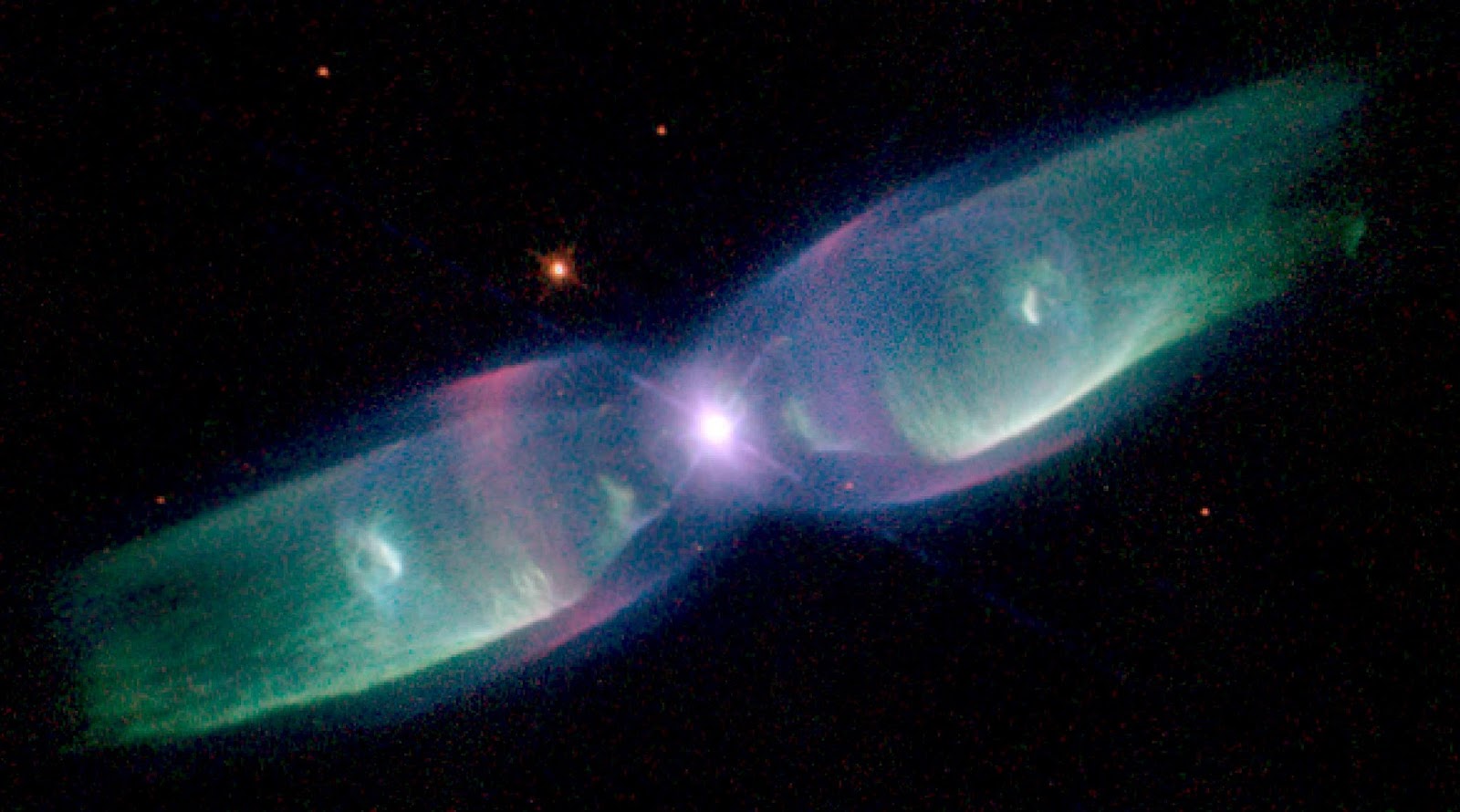
RPM Challenge 2015 Part IV: Twin Jet

Twin Jet Nebula in 2012
Track 3 from Impossible Universe -- Twin Jet.

When I first saw this image of the Twin Jet Nebula (also known as the Butterfly or Wings of a Butterfly Nebula), I wondered what it was; I'd never seen anything like it before.

I found out that William Herschel discovered the first one in the 1780s and dubbed it a planetary nebula, since the center of what he was seeing in his telescope looked like a planet. Modern science has shown that "planetary nebula" is a misnomer, but because Herschel's name for these astronomical phenomena was widely adopted, it's never been changed. (1)

Twin Jet is 2,100 light-years away, in the direction of the constellation Ophiuchus. Astronomers estimate that Twin Jet is about 1200 years old.

But what causes the twin jets? Well, planetary nebulae are formed when a star is at the end of its life. It sheds it outer layers, and the exposed star core illuminates these layers.

Twin Jet Nebula in 1997
But wait, there's more! The unique colors and shape of Twin Jet Nebula's two jets are because...there's actually two stars there! Twin Jet is actually a bipolar nebula, and the jets are caused by the motion of the two stars around each other.

The blue areas on either side of the binary star system are actually jets of gas being violently shot into space at an estimated 620,000 miles per hour. (2)

If there was sound in space (which there isn't), I imagine that the Twin Jet nebula might sound like the beginning of its namesake track from Impossible Universe...


(1) https://en.wikipedia.org/wiki/Planetary_nebula
(2) https://www.spacetelescope.org/news/heic1518/

Saturday, January 16, 2016

RPMChallenge 2015 Part III: The Pillars of Creation

The Pillars of Creation
Impossible Universe's second track. The Pillars of Creation.

This cosmic spectacle was discovered when the Hubble telescope took the first close-up pictures of the Eagle Nebula in 1994. (1) This particular part of the nebula got the name "The Pillars of Creation" because of the stars forming in the dust and gases that make up these pillars.

I've seen this picture many times: NASA's APOD (Astronomy Picture of the Day), Space.com, Pinterest...(yes I have a Pinterest account with an Astronomy board...you can check it out here). But as I was searching for inspiration for this project, I ran across this again and was mesmerized by this particular close-up of the nebula.

The Eagle Nebula (M16).
The Pillars of Creation are just
off-center to the left.
Eagle Nebula is about 7000 light years away from us and can be found between the constellations Serpens and Sagittarius. The entire nebula measures 70 light-years high by 50 light-years wide, with the tallest of the pillars being about 4 light-years high. (2)

Each of the "finger-like" tips of the pillars are larger than our solar system, and contain dense knots of gasses, and stars are being formed inside some of these.

I wanted to evoke the feeling of being in some sort of space vessel floating amongst the gas, dust, and newly-forming stars. I imagined the sheer size and majesty of these pillars of creation, and what it might be like to be much, much closer to them. I realize that if we, in our imaginary spacecraft, were closer somehow, it probably wouldn't look much different than where we are now on earth, considering the sheer immensity of just that one four-light-year pillar.

Still, the song is meant to be just that; a moment in time, a snapshot of floating amongst the majesty and wonder of The Pillars of Creation.


(1) https://en.wikipedia.org/wiki/Pillars_of_Creation
(2) https://en.wikipedia.org/wiki/Eagle_Nebula

Tuesday, March 31, 2015

RPMChallenge 2015 Part II: Nebulosity (Deep Architecture)

Nebulosity (Deep Architecture), the first track from Impossible Universe, has a couple of inspirations.

I started writing it during some composing and rehearsal work for another band I've worked with called Kalaban. We were working on one of the tracks for an upcoming release, and Randy Graves, Kalaban's guitarist and composer, kept getting this error while working on it in Logic Pro X:

Deep Architecture. Please unpack some files.

...uh...how very helpful! Google was of little help, and what help Randy did find didn't seem to fix the problem.

However after seveal weeks of fighting this particularly nasty and cryptic error, Randy finally solved it; I however don't remember the cause or the solution. Anyway, I'd been wanting to write a laid-back house-y track, and this incident and it's strange error prompted a track, and it's working title was the aforementioned "Deep Architecture."

So the rules of the RPM Challenge state that one needs to complete 10 songs or 35 minutes worth of music in the month of February. One can complete and already-started track and count it during that time. So since "Deep Architecture" was about half-complete, I decided to "repurpose" it for the challenge.


One astronomical object visible in the Northern Hemisphere's fall and winter sky that has always been interesting to me is The Pleiades. It is a star cluster within the constellation Taurus, and it's also called M45, The Seven Sisters, and, in Japanese, Subaru (if you look at the logo on a Subaru, you'll see that it's...seven stars....)

There are several interesting historical and mythological bits about The Pleiades:
  • Halloween is believed to originate from a Druid rite that coincided with the midnight culmination of The Pleiades, that is, when it reaches its highest point in the sky - at midnight.

  • The Zuni of New Mexico call the cluster "The Seed-Stars", and use it's disappearance from the evening sky in the spring as a sign that it's time to plant seeds.

  • "Pleiades" in Greek may mean "to sail." The Greeks used the star cluster's appearance in the morning sky before sunrise as the opening of the navigation season.

  • And of course the Greeks had a myth about the star cluster's origins. You can find the complete myth here. (1)

And here are the facts:
  • The Pleiades is an open cluster, consisting of mostly hot blue stars formed within the last 100 million years.

  • It is 444 light years from us in the direction of the constellation Taurus.

  • The faint glow around the cluster, called a reflection nebulosity, is not dust in the vicinity of the star cluster, but is dust in the interstellar medium that the stars are now passing through.

  • The names of the nine brightest stars in the cluster are: Sterope, Merope, Electra, Maia, Taygeta, Celaeno, Alcyone, Atlas, and Pleione (these last two are the seven sisters' parents). (2)
As you can see from the images above, Pleiades does have a nebulous quality to it, something I didn't realize until I started researching the subject of Impossible Universe's first track.

The word "nebulosity" kept appearing in the research I did. I decided that would be the title. I also decided to keep the working title because to me, the universe and its myriad features represent "architecture" on the grandest scale imaginable, beyond our mere mortal capacity to understand and fathom.

Nebulosity (Deep Architecture), then. The first track on Impossible Universe.


(1) http://earthsky.org/favorite-star-patterns/pleiades-star-cluster-enjoys-worldwide-renown 
(2) http://en.wikipedia.org/wiki/Pleiades

Friday, March 6, 2015

RPMChallenge 2015 and the Impossible Universe

A good friend of mine introduced me to the RPM Challenge late last year. In a nutshell, the challenge is to record an album's worth of music during the month of February -- 10 songs or 35 minutes worth of music.


As soon as I decided to accept it, I knew what the album would be about -- and so "Impossible Universe" became my RPM Challenge project for 2015.

As you may or may not be able to tell, my fascination with astronomical topics runs deep, and this album's concept is the first of many that explores our amazing universe.


2014 turned out to be one of my most musically stagnant in recent years, thanks primarily to a crappy day job that seemed to suck the creative life right out of me. Even after I left that place in the fall of that year for a *much much* better job, I still struggled to get anything done musically.

There's nothing like a challenge or a goal to push and prod one to activity, and the RPM Challenge did just that.

Now, a few days before February 1st, I settled on the track listing for the as of yet unnamed album:
  • Track 1: Nebulosity (Deep Architecture)
  • Track 2: The Pillars of Creation
  • Track 3: Twin Jet
  • Track 4: M31
  • Track 5: Hymn for the Universe
One of the caveats of the challenge is that tracks just need to be completed and releasable in February. I had been writing track 1 under the working name "Deep Architecture," and track 5 was only a 16-bar chord progression.

With that, I began. I found these images of to use as inspiration during the writing phase:

The Pleiades


The Eagle Nebula


Twin Jet Nebula


The Andromeda Galaxy


The Ultra-Deep Field

With such wonderful, beautiful, awe-inspiring images of these elements in our universe, this project was shaping up to be a fantastic experience.

More to come.....

Tuesday, December 23, 2014

Merry Christmas 2014 -- Some Children See Him

Merry Christmas!

Here's the fourth installment of Christmas remixes. This year I decided to do Some Children See Him. (Click the image below to listen.)


I first heard Some Children See Him on George Winston’s album December. His version is without lyrics, so for years I was unaware that it actually had words, and unaware of this Christmas song’s history.
Some Children See Him was written in 1951 by Alfred Burt, with words by Wilha Hutson. Years earlier, Burt’s father, a pastor of an Episcopal church in Michigan, started a tradition of writing a musical Christmas card to family and friends, the words and music written by himself. Soon however, he asked his son to provide the musical settings for his words.
After Burt’s father died, Alfred asked friend Wilha Hutson to provide the words, and the tradition continued in his father’s honor, but the carols were unknown outside the Burt’s mailing list.
The carols were finally recorded in 1954. Some Children See Him appeared on that first recording, and since then, several musicians have recorded their own version. George Winston, Kenny Loggins, and James Taylor have all provided their renditions of this carol.

Some children see him
Lily white
The baby Jesus
Born this night
Some children see him
Lily white
With tresses soft
And fair

Some children see him
Bronzed and brown
The Lord of heav'n
To Earth come down
Some children see him
Bronzed and brown
With dark
And heavy hair

Some children see him
Almond-eyed
This savior whom
We kneel beside
Some children see him
Almond-eyed
With skin
Of yellow hue

Some children see him
Dark as they
Sweet mary's son
To whom we pray
Some children see him
Dark as they
And, ah
They love him, too

The children
In each diff'rent place
Will see
The baby Jesus' face
Like theirs
But bright
With heav'nly grace
And filled
With holy light

O lay aside
Each earthly thing
And with thy heart
As offering
Come worship now
The infant king
'Tis love
That's born tonight

Monday, March 10, 2014

M-Theory: Hitchhiker's Guide to the Galaxy

The second installment of the M-Theory series, the EP M-Theory: Hitchhiker's Guide to the Galaxy is finally done and available on CDBaby, iTunes, and Amazon.com.


This second M-Theory EP is, obviously, inspired by the hilarious Douglas Adams series Hitchhiker's Guide to the Galaxy, which started out as a BBC radio program in 1979. Adams eventually developed this into a 5-book series (a sixth book, And Another Thing... was something Adams had always intended to write, since he felt Mostly Harmless was too bleak. Eoin Colfer was commissioned to write And Another Thing... in 2009).

The BBC also aired a television series in 1981, and in 2005, a major motion picture was released, with the title character of Arthur Dent played by Martin Freeman (of Sherlock and The Hobbit fame).

The tracks on this EP are:

  • Don't Panic
  • 42
  • Restaurant at the End of the Universe

In upcoming posts, I'll give a behind-the-scenes look at the inspiration behind and the writing process of these tracks.

I had a great time writing and producing these; I hope you like them.

Monday, November 4, 2013

"TwoAMonth" Ambient/Chillout/Experimental Tracks, Direct To You!

So about two weeks ago I was in the studio working on a remix, looking for a suitable sound for one of the tracks. I came across a sound that was really cool, but not for what I was working on.

I fiddled with it for a bit, started playing different things, and ended up with something I thought was pretty cool. So I recorded it, named it E8xE8, and uploaded it to SoundCloud.

I had so much fun doing that one that I decided I would try an experiment: could I do a track every other week; write, record, mix, and master all in a couple of hours?

So then last Friday I took a song I had just learned, Ivan Sings by Aram Khatchaturian, re-imagined it in a couple of hours, renamed it The 11th Dimension, and uploaded it.

I found this approach to songwriting and recording extremely challenging, refreshing and quite fun.

The tracks from this experiment will all be downloadable from Soundcloud; I hope you enjoy them, and I certainly welcome any feedback.